
Pruning
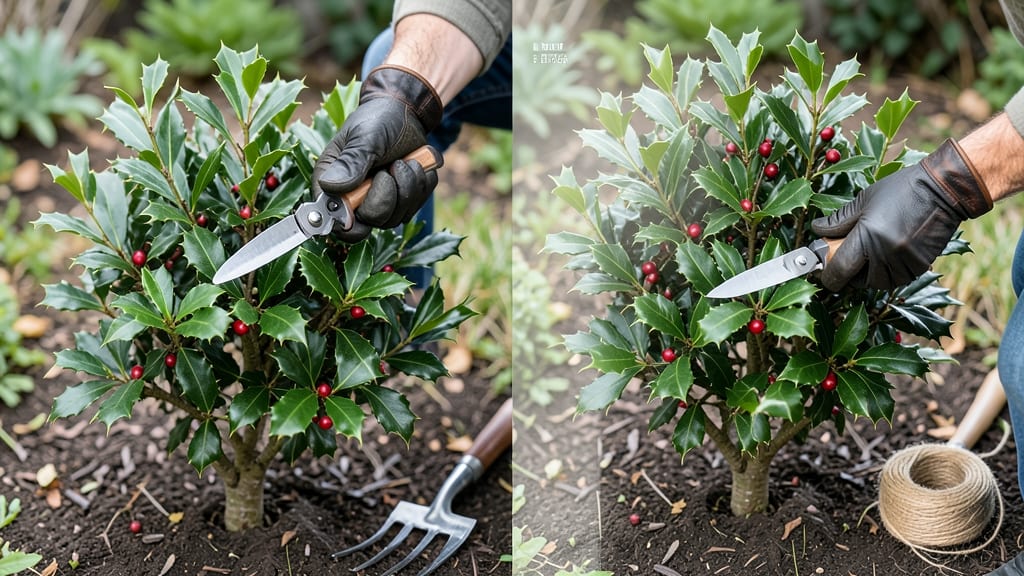
To prune holly bushes, do it in late winter or early spring just as new growth starts, before buds open. This timing prevents damaging developing flowers or attracting pests. Avoid pruning during active growth or after summer blooms to preserve next year's berries.
Pruning holly at this precise time taps into the plant's natural dormancy cycle. 🌱 When you trim during late winter, you're working with the holly's built-in survival mode—its energy is focused on root development rather than foliage, making it less stressed by pruning.
The key is to finish before spring buds swell, as cutting into new growth can stunt flowering and berry production. I've seen many gardeners accidentally prune too late, only to be disappointed when their bushes skip berries the following year.
This timing also minimizes pest attraction. Holly's sap is less appealing to insects when the plant is dormant, reducing the risk of introducing diseases through fresh cuts. For best results, use sharp bypass pruners and never remove more than one-third of the plant's foliage in a single session.
Always cut just outside the branch collar where it meets the main stem for cleanest healing.
💡 In This Article
- Holly Growth Cycles and Pruning Science
- Step-by-Step Holly Pruning Guide by Season
Holly growth cycles and pruning science
The ideal late winter/early spring pruning window aligns perfectly with holly's dormancy phase, when the plant's metabolic activity slows to 5-10% of summer levels. During this period, holly's energy reserves are concentrated in roots and dormant buds, making it far more resilient to pruning stress.
The buds that will produce next year's flowers and berries are already formed but remain tightly closed—cutting too early risks removing these critical growth points, while waiting too long risks damaging them as they swell with sap.
Berry production follows a precise timeline: flowers bloom in late spring (May-June), pollinated flowers develop into berries by summer, and they ripen over winter. Pruning after summer blooms removes potential berry-producing branches, which explains why many gardeners see fewer berries after late-season cuts.
The plant's hormonal balance shifts dramatically—what would have been berry-producing wood becomes just foliage if pruned at the wrong time. 🌿 For example, American holly (Ilex opaca) requires both male and female plants for berries, and pruning male plants too aggressively can disrupt pollen production needed for fertilization.
Over-pruning weakens holly's structural integrity by removing too much leaf surface area, which reduces the plant's ability to photosynthesize. Holly's thick, leathery leaves are adapted to shade tolerance, but excessive pruning forces the remaining leaves to work harder.
Studies show that removing more than one-third of foliage in a single session can reduce next year's growth by 20-30%, as the plant diverts energy to regenerate rather than produce new flowers.
The plant's natural pruning response also triggers increased branching from lateral buds, which is why holly often grows denser after proper pruning.
Pest avoidance is another critical factor. Holly's sap contains tannins that deter many insects, but fresh cuts expose vulnerable tissue. Pruning during dormancy minimizes sap flow and reduces the risk of introducing fungal spores or borer beetles through open wounds.
I've noticed that holly bushes pruned in late summer often develop sooty mold from increased sap exudation, attracting sap-sucking insects like scale. The plant's natural defenses are strongest when pruned during its natural rest period.
Consider the specific holly variety—English holly (Ilex aquifolium) and inkberry holly (Ilex glabra) have slightly different growth patterns. English holly, for instance, produces berries on current season's growth, while inkberry relies more on older wood.
This means timing adjustments may be needed based on your specific holly type. For example, inkberry can tolerate slightly later pruning (early spring) without affecting berry production as dramatically as English holly would.
Temperature plays a subtle but important role in pruning timing. In colder climates (USDA zones 5-6), holly enters dormancy earlier, sometimes as early as November, making December-January ideal. In warmer zones (7-9), dormancy extends until February-March.
The 10°F average daily temperature threshold is a good general guideline—prune when temperatures consistently stay above this mark to prevent shock to the plant's vascular system.