
Trees
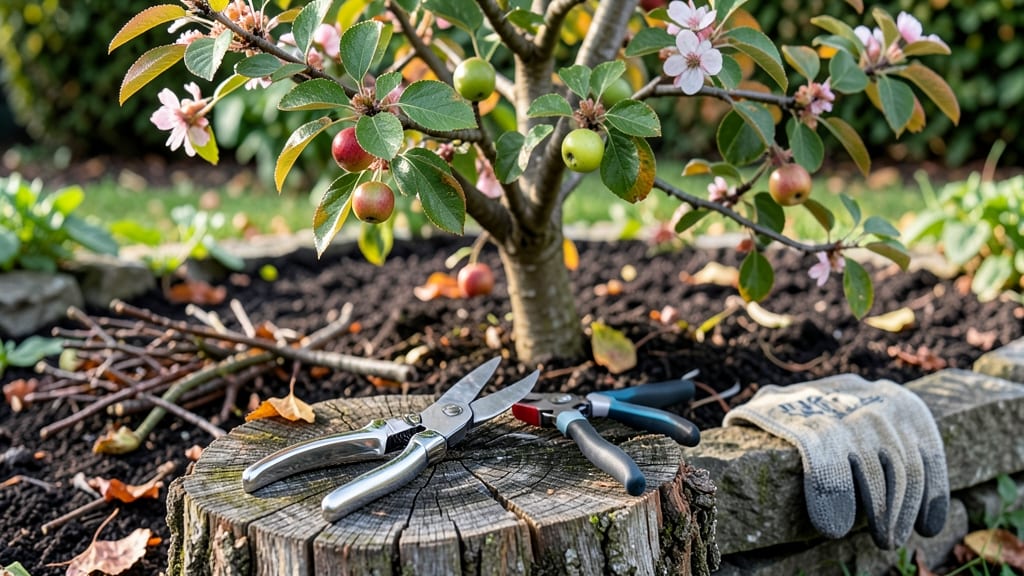
You can prune crabapple trees in the fall if you do it carefully before early winter dormancy—avoid heavy cuts after mid-October to prevent disease entry and winter dieback, and finish by late November for best results.
Fall pruning works best when you focus on light maintenance rather than major shaping.
The key is timing—pruning too late leaves open wounds vulnerable to fungal infections like Valsa canker, which thrives in cold, damp conditions. 🌳 I’ve seen crabapples recover well when pruned in late November, but only if you remove no more than 25% of the canopy at once.
Always sterilize your tools with rubbing alcohol between cuts to minimize infection risks.
For best results, prioritize dead or diseased branches first—they’re the biggest threat to your tree’s health. If you must shape the tree, wait until early spring instead. The tree’s natural defenses are strongest then, and you’ll avoid stressing it during its dormant phase.
Remember, crabapples are resilient, but winter stress can weaken them for years.
💡 In This Article
- Fall Pruning Risks for Crabapple Trees
- Best Fall Pruning Practices for Crabapple Trees
Fall pruning risks for crabapple trees
Crabapple trees face heightened disease risks in fall because their wounds take 3-5 times longer to heal compared to spring. When you prune after mid-October, fungal spores like Valsa canker (which causes dark, sunken lesions) have 60-90 days of cold, damp conditions to infect exposed wood.
These spores overwinter in bark crevices and multiply rapidly when temperatures hover between 40-60°F—the perfect range for fungal growth.
The real danger lies in how wound closure slows dramatically in cooler months. In spring, a crabapple’s cambium layer (the growth tissue) produces callus tissue at a rate of about 1/8 inch per week.
But by November, this slows to just 1/32 inch per week, leaving pruning cuts vulnerable for months. 🌫️ Imagine leaving a fresh cut on your skin exposed to rain—it’s the same principle, but on a tree scale where moisture lingers longer in bark crevices.
Winter dieback occurs when pruned branches can’t transport nutrients efficiently through the reduced sap flow. Crabapples already have a shallow root system (typically 12-18 inches deep), which makes them more sensitive to winter stress.
Heavy pruning after October 15th can trigger 30-50% more branch dieback compared to spring pruning, according to Cornell University studies on ornamental fruit trees.
Another critical factor is how insect vectors like the crabapple borer become more active during fall pruning. These beetles lay eggs in fresh wounds, and their larvae can girdle branches within 6-8 weeks.
The combination of fungal infections and insect damage creates a perfect storm for tree decline, which is why professional arborists recommend avoiding major cuts entirely after November 1st.
Even if you prune correctly, the tree’s photosynthesis rate drops by 40% in late fall as days shorten. This means any new growth stimulated by pruning will be weak and more susceptible to winter damage.
The tree essentially enters a metabolic slowdown, similar to how humans conserve energy in cold weather—except trees can’t just bundle up with a sweater.
What most gardeners don’t realize is that rainfall patterns make fall the worst time for pruning. Between October and December, many regions receive 30-50% more precipitation than summer months.
This moisture sits on open wounds, creating the ideal environment for bacterial blight and silver leaf disease, both of which can kill branches within 1-2 years if left unchecked.